I am sure we all read it. 34-year-old, Jessica Gentry’s Facebook post on why she quit teaching that went viral. And it got me thinking. Would I ever make that choice? Have I ever made that choice? Have I ever chosen myself over teaching–over my students? Yes. Yes, I have. And I am not the only one. The problem I chose to analyze is one from my own school. My school–Bartlett High School in Illinois–had the highest number of teacher absences in the district. An analysis of the national teacher absence reports and teacher satisfaction surveys will identify the causes and strongest reasoning for the high number of teacher absences and offer a solution to benefit the school–i.e. Bartlett High School, teachers, and ultimately, the students.
The Problem
(Bartlett High School, 2018 & Harwin, 2018)
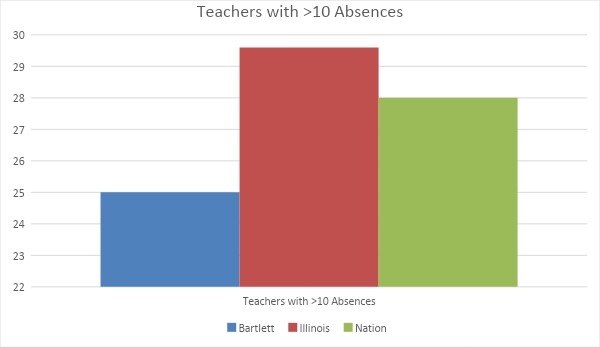
What do these numbers mean? Bartlett High School’s report card shows that 25% of our teachers had more than 10 absences, ranking us just under the national and state average. It means that nationwide, “more than 901,500 pre-K-12 teachers who were not at work when they would have otherwise been expected to be, according to an analysis by the Education Week Research Center of recent federal data” (Harwin, 2018). To put it in perspective, that means “1 in 4 U.S. teachers are chronically absent” (Terada, 2018). With 129 teachers on staff at BHS, that means 32.
Frontline, a program the records and manages absences, reports that last year, there was only an “ 84% percent sub fill rate” in secondary schools. And I believe it. The subs literally could not keep up. Our Assistant Principal would send out an email the night before warning of a Sub-a-Palooza the next day–encouraging us to take a position; discouraging us from calling in sick last minute. Almost every morning, emails would go out starting at 6am with all the unfilled positions. There were sometimes 20 class periods unfilled. Our Principal’s secretary would stalk our office before first period hoping to guilt one of us into subbing for a period, or multiple periods even. My colleagues made it a game. Who could sub the most periods in a school year? First place filled 141 periods, runner up was close at 134. And that was just in the English office.
In Module 1, I reflected on teachers’ lack of empathy for students. It was what I considered to be a major problem in my school. Teachers are not taking the time to get to know their students. And why? Our class sizes have exceeded 36. We have no time or energy for empathy, and as a result, respect among teachers has gone down significantly. Teacher referrals are up. Classroom disruptions have increased. Could this be why teachers are not showing up? Is this why I am not showing up? The number of teacher absences is not the only problem. Something is wrong with the teachers. They are dissatisfied. And if it is not fixed, the students will only suffer more.
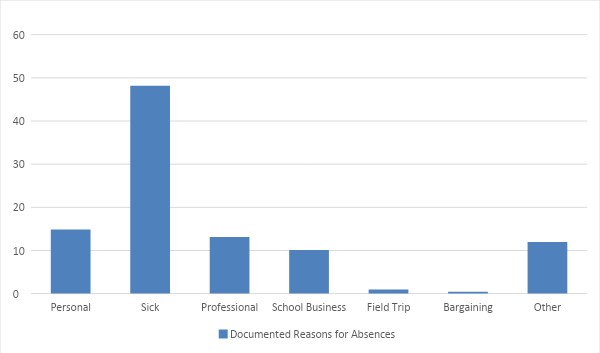
Teacher absence data. According to a report from the Bureau of Labor, “workers in education, training, and library occupations are more likely to be absent compared to the majority of other professional and related occupations. The only two occupational groupings with seemingly higher absence rates than educators are community and social service and health-care practitioners and technical occupations” (Harwin, 2018). The first set of data supports that fact. These positions can be draining physically, but also mentally, emotionally, and psychologically. Here is a breakdown of the documented reasons for absences as reported to Frontline in the 2019 School year.
(Frontline, 2019)
“School district administrators do not know what exactly is causing excessive teacher absenteeism. Some point to teachers taking sick leave, maternity leave and personal days to which they are entitled” (Terada, 2018). And the data supports this. As you can see, Sick Day is the highest reason with 48.2% and Personal Day as a close second with 14.87%. Personal days can mean anything. They require no explanation. In fact, most districts only give you two personal days–the rest being sick days. You see, you get more sick days, but those sick days require an explanation. They come with an immense amount of guilt. Guilt that you are leaving your students; guilt that your classes might not get filled by a sub. With sick days, you have to make excuses, justify your reasoning, find time to get a doctor’s note, and in a lot of cases, you talk yourself out of taking them for fear of having your pay docked because you were not exactly “sick.”
I spent my time on this assignment researching the teachers. What is causing so many of us to take days? Was it more than influenza? Afterall, Frontline shares data from the CDC that only 4.7% of teachers reported flu related outpatient visits (Frontline, 2019). So, are we really abusing them? Or do we need them? I started with teacher job satisfaction. After compiling all the data from three sources, I have concluded that some teachers take legit sick days for themselves or their children, and others take mental health days because they are simply stressed and need a break.
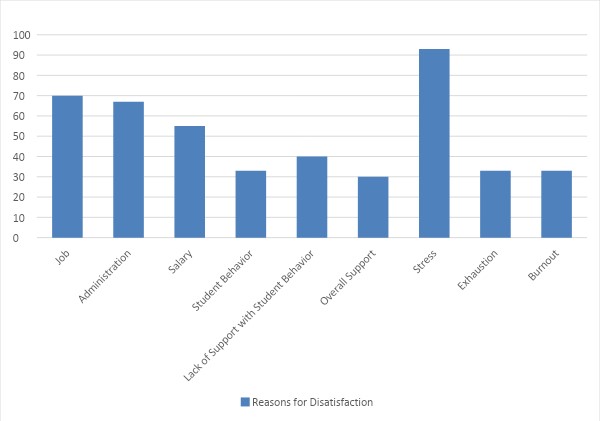
Teacher dissatisfaction data. After research, it is obvious: teachers are dissatisfied. Below is a line graph detailing teachers’ response for dissatisfaction.
(Will, 2018, Matos, 2016, & Frontline, 2019)
Teachers are dissatisfied with everything from their jobs (70%), salaries (55%), and administration (67%). Student behavior plays a roll (33%), and the lack of support with misbehavior (40%) and other overall support (30%). But where I got stuck was the latter three areas: stress, exhaustion, and burnout. Stress comes in at 93%. Exhaustion (33%) and burnout (33%) round out the list. In case you missed it. Ninety-three percent of teachers report that stress is a factor for job dissatisfaction. Ninety-three percent.
Analysis. Stress is the number one factor.
Many factors can contribute to high levels of teacher stress, but Geving (2007) suggests student behavior is an increasing factor of the stress, especially among secondary level teachers. In her study, she found 10 specific student behaviors to be statistically significant contributors to teacher stress…: hostility towards the teacher, not paying attention during class, noisiness, lack of effort in class, coming to class unprepared, hyperactivity, breaking school rules, harming school property, hostility toward other students, and lack of interest in learning. (Fisher, 2011)
A lot of these student behavior can be solved by having empathy for the students. Giving them the time to care and listen. But time is something we do not have. Teachers in my school are being asked to give up their prep periods to sub for a class where the teachers are chronically absent. It is no easy gig. It is often not worth the money–or stress–but we do it anyway. It is a vicious cycle. Stress reads as the number one factor, but it isn’t the only factor. There are other school related issues. Teachers are getting burnt out having to combat cell phones and ear buds, for attention–for respect. Some teachers are trying to connect. But there is not enough time. We go home defeated. Tired. And who is checking in on us? Where is the support?
If we cannot help or get the support for our issues, our students suffer. If teachers get the support, teachers will show up and have less time out of the classroom. If we are given more time, we can spend more time with our students. Learn empathy. And maybe those ten issues causing most of the stress in teachers will decrease. It is a win, win. Teachers need support otherwise, as cited in Ingersoll and Smith (2004), the combination of [those] factors will result in nearly 50% of teachers leaving the profession before they reach their sixth year of teaching (Fisher, 2011). That statistic was published in 2004, and the problem has only gotten worse.
Solution. Teachers need time and support. Teachers should not feel bad for taking a mental health day as mental health days are defined as “a day taken as a mental break from the stress(es) of work” (We Are Teachers Staff, 2018). We aren’t abusing them. We need them. We are stressed, exhausted, and burnt out. All of which are symptoms worthy of a hospital stay or medication. Just ask Mariah Carey. We are justified in taking these days and labeling them as sick days. Mental health days do not need justification.
If we take the mental health days, we show up. Students get our time instead of a substitute or over-worked colleague. We are refreshed to be there for them. It is only then that we can begin to have empathy for them–when someone starts having empathy for us.
It is a lot to ask to get support from our schools. But School District U-46’s insurance provides three free counseling sessions – thus, we should get 3 mental health days: one 2nd, 3rd, and 4th quarter. It would give us time to recharge and talk to someone without costing the district anything as it is already a health benefit–one that few people take advantage of because of the stigma.
To quote Jessica Gentry,
My mental and physical health was in jeopardy every.single.day. Knowing that your kids need and deserve more than they’re getting. Sitting in one meeting after another, begging for more support,…knowing they need more than you can give them in a classroom of 21, with less and less support, multiple languages spoken, several different disabilities… it breaks you. We become emotional eaters. We…zone out. We become so short fused that our families suffer. So… that’s why. I finally realized…You can’t even help 21 if you aren’t healthy yourself. If your mental and physical health aren’t a focus, you aren’t even good for the 21. (Cachero, 2019)
Or in my case, my colleagues and myself are not good for the 5 classes of 36. The National Bureau of Economic Research has found that when teachers are absent for at least 10 days, there is a significant decrease in student outcomes. The decrease, according to one study, is equivalent to the difference between having a new teacher and one with two or three years of experience (Matos, 2016). The evidence is in the data. Too many teachers–especially Bartlett High School–are taking too many days off. The reason–stress–stress so debilitating that teachers cannot come to work. It is affecting the students–which have their own issues–they are neglected. Teachers are neglected. We all need support. Based on the data and analysis, I will support and promote the use of the district’s three free counselling services and encourage my colleagues to take the days–I know I will. I will make it my mission. Maybe in 2021, teacher absences will go down, and we can start to have empathy–for the students–for each other.
References
BARTLETT HIGH SCHOOL | School Snapshot. (n.d.). Retrieved July 17, 2019, from https://www.illinoisreportcard.com/School.aspx?schoolid=310450460220004
Cachero, P. (2019). 34-year-old’s Facebook post on why she quit teaching goes viral: “The filter comes off now.” Retrieved July 21, 2019, from https://www.yahoo.com/lifestyle/former-teachers-viral-post-why-quit-teaching-not-pay-230505130.html
Frontline. (2019). National Employee Absence & Subtitute Data | 2018 – 19 Report. Retrieved July 17, 2019, from https://www.frontlineinstitute.com/reports/monthly-reports/
Harwin, A., (2018). How Many Teachers are Chronically Absent from Class in Your State? Retrieved July 17, 2019, from http://blogs.edweek.org/edweek/inside-school-research/2018/06/chronic_absenteeism_teachers.html
Matos, A. (2016). 1 in 4 U.S. teachers are chronically absent, missing more than 10 days of school. Retrieved July 17, 2019, from https://www.washingtonpost.com/gdpr-consent/?destination=%2flocal%2feducation%2f1-in-4-us-teachers-are-chronically-absent-missing-more-than-10-days-of-school%2f2016%2f10%2f26%2f2869925e-9186-11e6-a6a3-d50061aa9fae_story.html%3fnoredirect%3don&noredirect=on
Terada, Y. (2018). Burnout Isn’t Inevitable. Retrieved July 17, 2019, from https://www.edutopia.org/article/burnout-isnt-inevitable
We Are Teachers Staff. (2018). Should Teachers Take Mental Health Days? Retrieved July 17, 2019, from https://www.weareteachers.com/mental-health-days/
Will, M. (2018). Nearly Half of Public School Teachers Are Satisfied With Their Salaries, Data Show. Retrieved July 17, 2019, from https://blogs.edweek.org/edweek/teacherbeat/2018/05/teacher_salary_job_satisfaction.html
 #Education